
Cost allocation and resource tags
Learn how to tag RunsOn resources with custom tags, as well as the default tags that are applied.
RunsOn tags all resources with default tags, and supports tagging resources with custom tags. This is useful to identify resources in your AWS account, help with cost allocation, and break down spend in AWS Cost Explorer.
How it works
RunsOn will tag all infrastructure resources with the CostAllocationTag key (default key: stack, value: the CloudFormation stack name).
For ephemeral resources (ec2 instances, disks, etc), RunsOn will tag them with the cost allocation tag, and any custom tags that you have defined.
EC2 instances will also be tagged with workflow-related tags (see Default tags below).
Default tags
RunsOn automatically applies the following default tags to EC2 instances:
| Tag Key | Description |
|---|---|
runs-on-workflow-job-started | Whether the workflow job has started |
runs-on-workflow-job-name | Name of the GitHub Actions workflow job |
runs-on-workflow-job-interrupted | Whether the job was interrupted |
runs-on-workflow-job-id | Unique identifier for the workflow job |
runs-on-workflow-job-conclusion | Final status of the workflow job |
runs-on-workflow-run-id | Unique identifier for the workflow run |
runs-on-workflow-name | Name of the GitHub Actions workflow |
runs-on-repo-full-name | Full repository name (owner/repo) |
runs-on-image-id | Unique identifier for the image spec used |
runs-on-runner-id | Unique identifier for the runner spec used |
runs-on-networking-stack | Networking stack configuration |
runs-on-labels | Runner labels assigned to the job |
runs-on-org | GitHub organization name |
runs-on-version | RunsOn version used |
runs-on-env | Environment configuration |
runs-on-role-id | IAM role identifier |
runs-on-integrations-active | Active integrations status |
runs-on-extras | Additional configuration extras |
runs-on-is-private | Whether the runner was launched in a private subnet |
runs-on-is-ghes | Whether running on GitHub Enterprise Server |
runs-on-stack-name | CloudFormation stack name |
runs-on-ami-name | Name of the AMI used |
The runs-on-is-private tag is useful if you want to break down usage between public and private runners, for example to understand which jobs are driving NAT gateway traffic.
Using RunsOn tags in AWS Cost Explorer
The default runs-on-* tags are standard AWS resource tags on the EC2 instances launched for your jobs. If you activate them as cost allocation tags in AWS Billing, you can use Cost Explorer to drill into where your RunsOn spend comes from.
The most useful tags to activate are usually:
runs-on-repo-full-nameruns-on-workflow-nameruns-on-workflow-job-nameruns-on-stack-nameruns-on-is-private
To enable them:
- Open the AWS Billing and Cost Management console and make sure Cost Explorer is enabled.
- Go to Cost allocation tags.
- Search for the
runs-on-*tags that you want to report on, then choose Activate. - If the AWS account where RunsOn is installed is a member account in AWS Organizations, do this from the organization’s management account (the top-level billing or payer account), not from the member account itself.
- Wait up to 24 hours for the tags to become active in billing data and show up in Cost Explorer.
- In Cost Explorer, group or filter by those tags to see costs per repository, workflow, or job.
Any custom tags you add through RunsOn can be activated the same way. For the AWS side of this flow, see the official guide on user-defined cost allocation tags ↗.
Custom tags
Custom tags can be set in different places:
-
custom tags defined in the
RunnerCustomTagsstack parameters. -
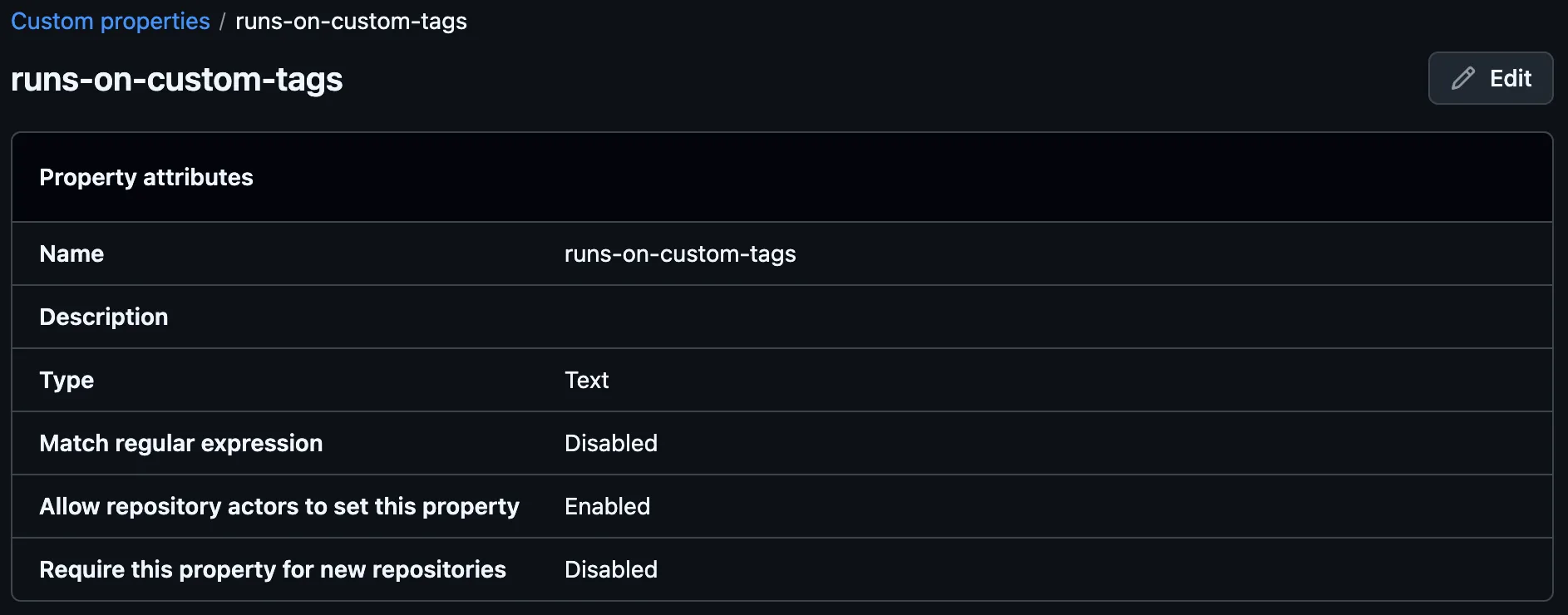
custom tags defined in a specific custom property of your GitHub repository settings. The custom property must be named
runs-on-custom-tags, and the value is a comma-separated list of tag keys and values, e.g.key1=value1,key2=value2.
- custom tags defined for a runner specification in the
runs-on.ymlfile.
If the same tag name is defined in multiple places, the precedence is as follows:
- Stack-level tags
- Custom property
runs-on.ymlfile